
AI Agents: The Evolution of Intelligent Automation

What Is AI Agent ?
An artificial intelligence (AI) agent is a software program that can interact with its environment, collect data, and use that data to perform self-directed tasks that meet predetermined goals.
It can also be described as a system that autonomously performs tasks by designing workflows with available tools.
Why Are AI Agents Popular Today?
AI agents have gained popularity due to recent advancements in large language models and tool integration. Modern models such as Claude or GPT can now reason, understand context, and interact with external systems.
This enables AI agents to go beyond simple responses and act as intelligent systems capable of analyzing information, making decisions, and executing tasks.
For businesses and developers, this means automation is evolving into intelligent task execution.
When Did AI Agents Enter Our Lives?
The concept of AI agents has existed for decades in academic research. However, their practical adoption accelerated after the rise of large language models (LLMs) around 2022–2024.
Types of AI agents
AI agents can be categorized based on how they interact with their environment:
- Simple reflex agents: Operate using predefined rules.
- Model-Based Agents: Maintain an internal model of their environment.
- Goal-Based Agents: Take actions to achieve a specific objective.
- Learning Agents: Improve their behavior based on past experiences.

How does an AI agent work?
- Determine goals: The AI agent receives a specific instruction or goal from the user. It uses the goal to plan tasks that make the final outcome relevant and useful to the user. Then, the agent breaks down the goal into several smaller, actionable tasks. To achieve the goal, the agent performs those tasks based on specific orders or conditions.
- Acquire information: AI agents require information to execute tasks they have planned successfully. For example, the agent must extract conversation logs to analyze customer sentiments. As such, AI agents might access the internet to search for and retrieve the information they need.
- Implement tasks: With sufficient data, the AI agent methodically implements the task at hand. Once it accomplishes a task, the agent removes it from the list and proceeds to the next one. During this process, the agent may create and act on additional tasks to achieve the final outcome.
Most AI agents operate in a continuous loop:
Agent Loop
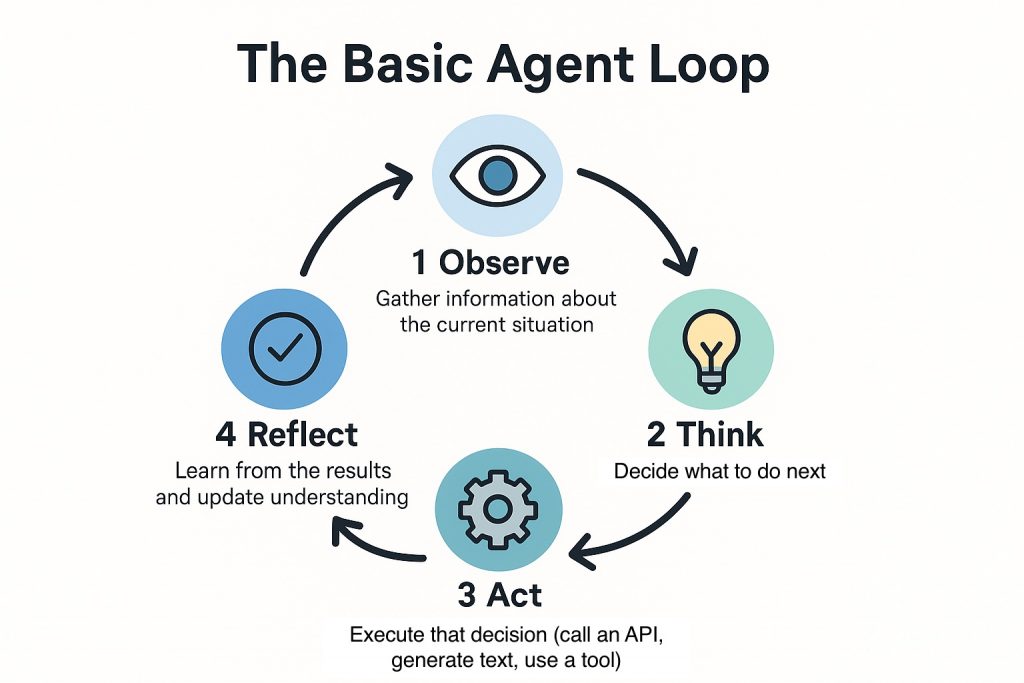
- Observe: Gather information from the environment
- Plan: Determine the best course of action
- Act: Execute tasks using tools or APIs
- Evaluate: Assess the outcome and adjust the next action
This loop enables agents to continuously improve their decisions while pursuing a goal.
Traditional Automation vs Agents ?
Traditional automation follows predefined rules and workflows. These systems execute tasks exactly as they were programmed.
AI agents, however, can analyze context, evaluate possible actions, and determine the most appropriate next step autonomously. AI agents operate independently without requiring continuous human supervision. Unlike traditional software that relies on predefined instructions, they determine the most suitable action by analyzing past data and carry it out autonomously.
For example, traditional automation tools review pull requests using predefined rules to detect issues. However, an AI coding agent can analyze the context of the code, identify potential bugs or performance problems, and autonomously suggest improvements.
AI vs AI Agents
Traditional AI systems typically respond to user prompts or perform specific tasks such as classification, prediction, or content generation.
AI agents go a step further by planning actions, interacting with tools, and executing workflows to achieve goals.
In other words:

- AI → responds to requests
- AI Agents → take action to accomplish goals
What Can We Do with AI Agents
AI agents can be applied across many domains:
- Software Development: Review code, detect bugs, and suggest improvements.
- Customer Support: Analyze user requests and generate contextual responses.
- Data Analysis: Collect, process, and summarize large datasets.
- Business Automation: Handle repetitive operational tasks and decision workflows.
These capabilities allow organizations to move from basic automation to intelligent task execution.
Multiple AI Agents (Agentic AI)
Another emerging concept is Agentic AI, where multiple AI agents collaborate to achieve complex goals.
For example:
- One agent gathers data
- Another analyzes the data
- A third generates insights or reports
This collaborative structure enables systems to solve complex problems more efficiently.
Challenges of Using AI Agents
- Reliability and Accuracy: AI agents make decisions based on data and probabilistic models. This means they may occasionally produce incorrect results or unexpected actions, especially when dealing with complex tasks.
- Control and Oversight: Because AI agents operate autonomously, maintaining proper control becomes critical. Without clear monitoring mechanisms, agents may perform actions that were not originally intended.
- Security Risks: AI agents often interact with external tools, APIs, and databases. If not properly secured, this can create potential vulnerabilities or unintended data exposure.
- Cost and Infrastructure: Running advanced AI agents frequently requires powerful models and continuous API usage, which can increase operational costs.
- Ethical and Trust Issues: As AI agents become more autonomous, questions arise regarding accountability, transparency, and trust in automated decision-making systems.
Related Words
- Evaluate (v): To carefully examine, analyze, or judge something in order to understand its value, quality, importance, or effectiveness.
- Encompass (v): To include or cover something completely
- Perception (n): The way someone sees, understands, or interprets something based on their senses, experiences, or beliefs.
- Autonomy (n): The ability of a system to operate and make decisions without constant human intervention.
- Large Language Model (LLM) (n): A type of AI model trained on massive text datasets to understand and generate human language.
- Context (n): Additional information that helps AI systems interpret data or instructions more accurately.
- Action (n): A task or operation performed by an AI agent in response to its observations or goals.
- Observation (n): The information an agent receives from its environment, such as data, text, or sensor inputs.
- Goal (n): The objective or outcome an AI agent is trying to achieve.
- Reasoning (n): The ability of an agent to analyze information and make logical decisions.
- Agent Orchestration (n): The coordination of multiple agents, tools, and processes working together.